
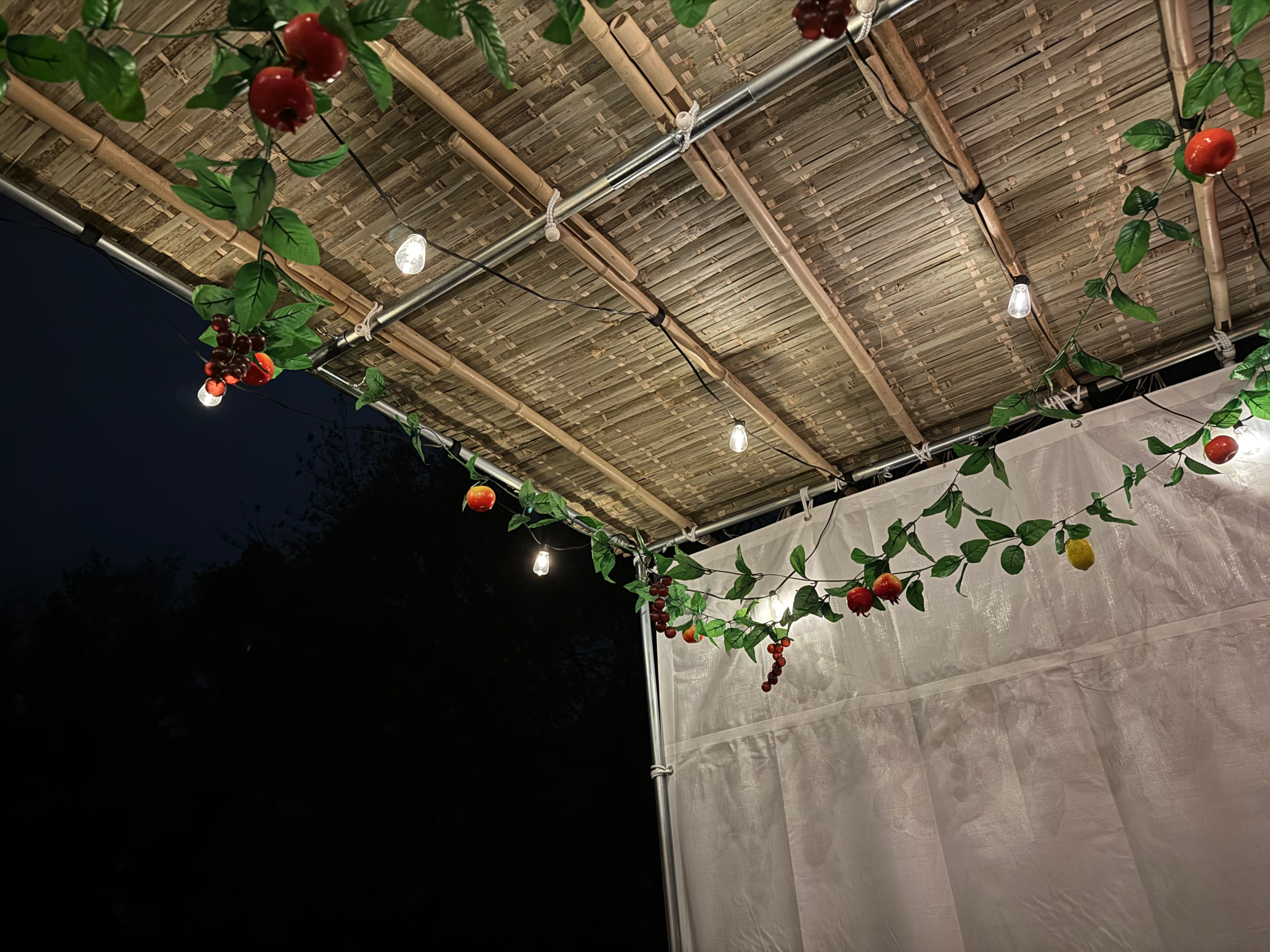
A few weeks ago, immediately after Yom Kippur, I lugged out various packages, boxes, and containers. Several metal and PVC pipes, bamboo poles, a roll out bamboo roof, decorations, tarps, and the list goes on.
I was building a sukkah — a temporary dwelling — for the first time in my life. In my backyard.
The “Laws of the Sukkah” are very specific in rabbinic literature. As far as I can tell, the one I built was halakhic (it met the criteria). My practice and use of it, however, was not 100% according to the many many many laws.
The religion nerd in me wants to talk about these laws and where I met them and didn’t meet them. That sounds like a great conversation over a glass of bourbon with a fellow religion nerd. But the Jewish communities I’m a part of are trying to imagine a Judaism that is less concerned with the guilt/shame of not fulfilling Jewish law 100% and more about the feelings and intent of the holidays and practices.
This is worthy of a larger exploration. But a few examples: Kosher laws? What about ethical eating whether it involves pork and shellfish or not? That one is controversial, but I know a lot of rabbis who will indulge some pulled pork, bacon, or crawdad bisque — if it’s locally sourced and not contributing to the exploitation present in factory farming. Fulfilling every obligation of the sabbath on Friday evening? What about a dozen of mini-sabbaths throughout the week in our culture of rush and bustle? Fulfilling every holiday to the letter of the law? What about embodying the spirit of the holiday?
That’s what I did with Sukkot — the festival of booths. Yes, my sukkah was by the book. But maybe next year I’ll modify it. Or maybe one year I’ll decorate the back porch or the sunroom. If any of my nieces and nephews go back to Jewish day school, maybe I’ll build a sukkah out of popsicle sticks with them instead of spending hours building a traditional one.
But I wanted to go all in this year. So, I did. I would have morning coffee and snacks in the sukkah instead of full meals. I certainly didn’t sleep in it like some Orthodox Jews do. I counted the stars in the sky looking through the shach (thatched roof), sat with the dog, my husband, and waved the lulav, which is like an ancient Hebrew rain dance. YEP! You read that right.
For the entire festival of Sukkot, this little hut was in my yard through rain, wind, sun, and more. But here’s how the holiday really impacted me:
It was in the putting together and taking down of the sukkah where I felt it most. Here I was, on a warm, sunny day — sweating to death, a little sunburned, and mildly cursing myself for going all in — building this temporary shelter. The entire time I was reflecting on how this festival is considered one of the most joyous ones in the Jewish religion. This? Joyous? Building a hut in the heat? What’s joyous about that? But then I felt it.
Though the Exodus did not happen as it is written, the story is powerful. It’s one of my favorite Biblical stories. Here is everything you need to know about life in a strange holiday with an intense story: Our whole lives we build temporary shelters…only to have to take it down, move on, pick up the pieces after a storm, rinse and repeat.
The joy comes not in the somber realization and weight of this wisdom but in the acceptance of it. More than acceptance, though. The embodying of it. It’s incredibly Zen. We want there to be permanent refuge in life — in our homes, our families, our communities, our bodies, our minds — but there isn’t. It’s all temporary. And somehow, embracing that, a deeper joy can be found.
That doesn’t mean it’s not hard. Unfair. Messed up. Tragic. I know too many good people who’ve had to deal with the insurmountable, while Donald Trump will probably live to 110. But I’ve also known those same good people who can still find delight and joy. Sometimes in surrendering to our lack of control, we can cherish whatever shows up in some way.
Just go ahead and think of all of the misery people cause themselves by trying to micromanage and control every facet of life.
So, here I was, in the wilderness, building a temporary shelter, knowing I would need to take it down eventually and keep moving. Keep moving with and through and into my life and keep moving with everyone else. Building that little hut while being baked by the sun became a moment where gratitude was felt deeply. It was strange. It was good.
I had gratitude for now being in my 40s with a good life, even if the second half of my 40th year presented some new (manageable) health adventures. Who am I now if I have to deal with a compressed c7 disc and an autoimmune condition? Well, I’m Brian, still. Just different. No refuge. Where did any of us get the illusion that life owes us stability?
As the holiday came to a close — and several neighbors asked weird questions about the hut — I felt myself go deeper as I took down the sukkah. Time to pack up. Time to move on. Find your joy in the moment and then get ready for the next thing. That’s how it is.
Some might call this fatalism. I don’t. It’s mindful acceptance. For all of the hoopla, laws, regulations, and whatever else we complicate our holy days and spiritual celebrations with — peel back one layer of the onion and there it is: a reminder to pay attention to life.
Once Sukkot comes to a close, there’s Simchat Torah, which involves the completion of the Torah and the immediate restart of it. The story ends with the death of Moses before the Hebrew people enter the Promised Land and, whoosh, we find ourselves hearing the words, “In the beginning…” The journey continues.
Until next time.
