
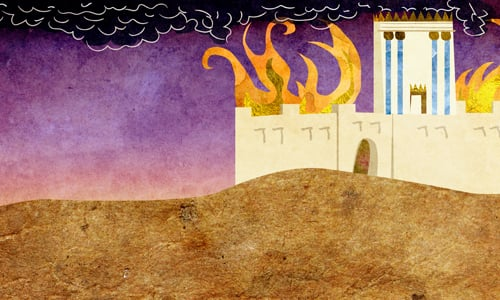
It’s the eve of my first holiday as a fully fledged Jew. I can’t wait! Bring out the decorations, the music, the special food, the joy of community, and…
No. Wait. Don’t do any of that. In fact…don’t eat a thing for 25 hours and mourn. It’s Tisha B’Av (literally means: The Ninth of [the Hebrew month] Av). It’s the Jewish day of mourning and one of two “obligatory” major fast days. If you’re a Reform Jew, you probably don’t fast. But as I am finding myself more in line with the Masorti and Renewal movements, I’m inclined to observe the day in a way that is both traditional and modern.
And I have a family picnic on the day of the fast. Hmm.
So what is Tisha B’Av? I’m not here to crank out the same material you can find on some excellent websites like this one and this one and this one. In short, it’s a day where several calamities that have befallen the Jewish people are, traditionally, said to have happened.
These include but are not limited to:
- The Jewish people were punished with 40 years of wandering in the desert.
- The First Temple in Jerusalem was destroyed by Nebuchadnezzar in 586 BCE.
- The Second Temple was destroyed by the Romans in 70 CE.
- The Fortress of Betar fell to the Romans in 135 CE.
- Emperor Hadrian established a pagan temple in Jerusalem in 136 CE.
- King Edward I signed the Edict of Expulsion in 1290 CE.
- The expulsion of Jews began in Spain in 1492 CE.
And that list could be much longer. It just makes you want to party all night long, right? But here it is. My first observance.
Though Tisha B’Av has become sort of a catch-all observance of historic tragedies that just so happened to occur on the same day, the destruction of the Temple (twice) is what this is really about. Let me be honest. I don’t have a deep emotional connection with the Temple in Jerusalem. I’m still figuring out what the Temple means to me, if anything. All I can muster is that it is a politically and religiously charged set of ruins. It means a lot to the Abrahamic faiths. As a religion nerd, the old Temple is fascinating as it relates to the history of monotheism. And then there’s this: The Dome of the Rock stands where the Temple did…and there is a frightening drive by Evangelical Christians to not only destroy the Dome of the Rock and rebuild the Temple, but to usher in the Second Coming by doing so. Oh, yeah, ultra-zionists want to destroy the Dome, too.

Who wouldn’t want to be Jewish after learning about Tisha B’Av and all of this extra baggage?
All of that aside, but not discarded, I can look to this coming day of mourning and find great meaning. How often in our culture do we have days of communal grief? Until 9/11 and the following anniversaries, Americans would turn any day of remembrance into an opportunity for fireworks and BBQ. For people that grew up Catholic or in another liturgical Christian tradition, can anyone really tell me how they observed the “fast days” on the church calendar? If you can, you were very observant.
And then there’s Unitarian Universalism. We’ve stripped away most holy days — joyous and otherwise. We sometimes keep Easter — for some indecipherable reason, love a good cultural Christmas, and we have our very own Flower and Water Communion. Everything else is up to the minister or the culture of the congregation. We don’t really do a liturgical year with regular feast and fast days or a long list of observances. And days of mourning? Well, it depends on who you ask. This isn’t about the shortcomings of UUism, but sometimes I look to certain sectors of this tradition and wonder where the joy went…and in other sectors, I wonder if we take anything serious at all. It makes me grateful to serve where I have and currently do.
I think we — the expansive we of Western culture — could use a day of true mourning. A day where we pour our disappointment, grief, and tragedy into a communal observance. Or maybe we start with our individual selves.
For me, while I have little connection, as of right now, to the Temple in Jerusalem, I know the places in my life where the walls came crumbling down. I know that pain. I know the places in our world where any sense of sacredness or joy is being snuffed out. I know when I’ve let my ego destroy possibility. I know what our country is going through.
This weekend, while I won’t be doing a full fast, I will do a partial one. I will do so because I need to give myself space to process and feel the depths of emotion around everything this world is facing. I mourn for: Gaza. Climate change. America. LGBTQ persons. The rise of authoritarianism. The dismantling of cultural institutions. Congregants who are suffering for many reasons. Family and friends who are suffering. My own suffering. And so much more.
The Temple walls are breached in my heart and I need to let the siege come to a conclusion. I need to know and feel the loss.
While I won’t be observing according to strict standards (maybe next year), I will read Eicha (the Book of Lamentations), which will be chanted in synagogues across the world. I will skip breakfast. I’ll not indulge in any unnecessary luxuries. I do this not because I think I’ll be rewarded for observing the day. I do this not because you, dear reader, are reading this. I do this because days of mourning help complement the days of joy, resistance, resilience, and celebration. We need them all…for ourselves. For each other. If only to remember. We need to remember.
The opening of Eicha has a different tone to it in this world we wake up to each day with a destroyed Gaza, authoritarianism unleashed, and everything else befalling us. And maybe I get it now, just a little. I get the mourning of the Temple. The holiest of holies is defiled.
How lonely sits the city
that once was full of people!
How like a widow she has become,
she that was great among the nations!She weeps bitterly in the night,
with tears on her cheeks;
among all her lovers,
she has no one to comfort her;
all her friends have dealt treacherously with her;
they have become her enemies.Judah has gone into exile with suffering
and hard servitude;
she lives now among the nations;
she finds no resting place;
her pursuers have all overtaken her
in the midst of her distress.
Until next time. Here’s a traditional song sung on Tisha B’Av – “Eli Tzyion.”