
שְׁמַע “Listen.” The first word of the Sh’ma, the statement of faith for Judaism. If I had my way, any faith statement would begin and end with that word. Listen. Just listen. In Hebrew, which I’ve come to love in ways I never expected, every letter and word offers doorways of endless meaning. “Sh’ma” doesn’t simply mean listen. It means perceive, understand, and from that deep listening — pursue action.
My first real Jewish experience was in undergrad. I was attending Elmhurst College and majoring in Theology & Religion. I was one of those college students, involved in everything. My greatest disappointment from college was that I wasn’t allowed to have three minors. That’s kinda weird, but illustrates a point. I was a terrible high school student, but I excelled in college. I finished my major in one year and had nothing but time on my hands to take whatever I wanted. Urban Planning and Intercultural Studies (especially Queer Theory, which is about so much more than LGBTQ+ topics) were constant companions while I exhausted the Theology classes.
So, anyway, the cool Theology & Religion kids and I would attend various churches and religious groups often. Wisconsin Synod Lutherans? Why not? This or that Evangelical, Latter-day Saint, Jehovah’s Witness, Baha’i, Hindu, Muslim, and so on…bring it. And, of course, Friday night Shabbat at a local Reform Jewish Temple.
At this point in my life discernment, I was convinced I could fit in nicely either as a UU minister or an Episcopalian priest. I loved the smells and bells of the Episcopalians. I figured I could get used to the Jesus thing (newsflash: I couldn’t.) if I went down that path. Or maybe this ministry thing wasn’t for me anyway. Urban Planning school sounded great. (It wasn’t.)
Though I return, again and again, to the world of Unitarian Universalism, I have to say that my first visit to a Reform Temple rocked my world. And there are melodies and moments from that visit and many visits to follow that are still with me. Or, rather, they linger and foster longing. A deep longing without a name.
One of the very few students that was a part of our campus Hillel group came with us. He was, looking back, but, really, we knew it then — a Jewish young adult who was struggling mightily with his Jewishness. It brought him great pain. And he lashed out at a lot of folks. I hope he found peace eventually. But he had his great moments, which is why we liked him. Anyway, he came with us to show us what was up.
Upon entering the temple, I was immediately drawn to the little shop. Jewish communities almost always have a little shop and, well, be still my heart, I love a little shop. “Ummm, can I buy on of the little hats?” “No. It’s called a kippah.” “Why not? I’d totally wear…a…kip…erm.” “Kippah. It’s shabbat. We don’t sell things on shabbat.” “Oh.” “You can wear this one.” He brought extras.
We took up an entire row in the sanctuary. The Rabbi, a now retired man who looked as if he was always sizing people up with amusement, came to greet us. Then the service began.
I have very few solid memories of that first shabbat service, but the ones that are with me are indelible. This includes, of course, our arrival. My crash course in the dos and don’ts of shabbat with our dear friend. I remember being lost in the language. It all moved so fast. At the very end, at oneg (Jewish coffee hour), I remember the kiddush (sanctification) prayer and how powerful that felt before the wine.
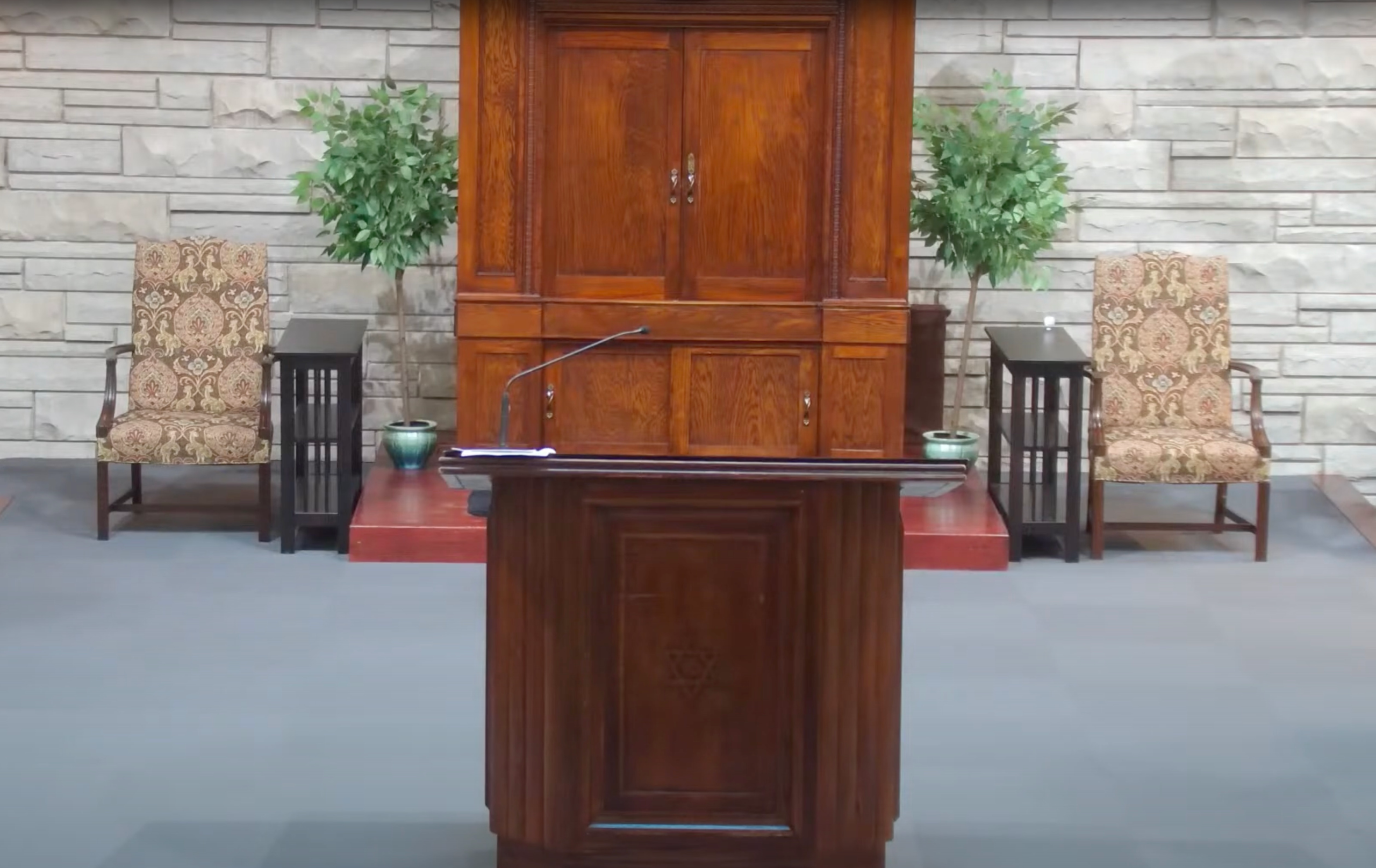
But what I remember most is when the Torah scrolls were taken out of the Ark — the large wooden standing chest behind the bimah (pulpit). I couldn’t help but think of the Catholic or Episcopalian services I had been a part of — but instead of seeing little wafers of bread taken out of a small ornate tabernacle, giant scrolls were taken out of a humble wooden chest. And I realized, this practice was older than wafers in a marble and gilded tabernacle. This moment hearkened back to the Holy of Holies of the Temple in Jerusalem. It’s a dangerous road in religion to tempt reductionism, but the feeling was just that. These giant scrolls were tethered in a way bread and wine were not.
The Rabbi grabbed one of the scrolls and proceeded to dance into the congregation. All the while, an exuberant rendition of the Sh’ma was played. It started slow and quickly picked up pace with each verse. Bodies started moving to the rapid beat, hands were clapping, feet stomping — and people kept their eyes on the scroll, turning with it as it moved around the sanctuary.
They’d reach out with their siddurim (prayerbooks) — touching them to the giant scroll and then kiss the book, all the while still moving to the joyous music.
She-ma yisrael, adonai eloheinu, adonai echad!
Baruch shem kavod malchuto l’olam va-ed!
Over and over again until the entire congregation had a chance to be in its presence. As the scroll passed by us, I reached out with my siddur and touched it, brought the book to my lips, and kept my eyes locked on the scroll. This wasn’t a Michelangelo’s “Creation of Adam” experience, my finger touching the divine. But kissing that prayerbook was visceral. Something changed and that change stayed with me.
The Rabbi was breaking a sweat, a giant smile on his face the entire time. People were ecstatic. I was speechless.
I can still sing that song. I still hear it randomly, now two decades later. I’ve never quite found a version of it that captures the joy and energy of what I experienced, but I did find a very very slow version of it. Imagine that being sung much faster, with people dancing.
And that was it. The defining moment. The one that stuck with me. Looking back, I can easily ask myself: Should I have gone deeper right there and ended up in rabbinical school instead? I don’t think that would’ve served me well. I am where I need to be. I have no longing for the rabbinate. Though, to be honest, I’ve always found UU ministers have far more in common with Rabbis than Protestant ministers. I hear some of my dear Protestant colleagues talk about their work and…have no idea what on earth they’re talking about.
There’s a couple other pieces of why that experience just sat with me for almost two decades. First, I was under the impression that you couldn’t convert to Judaism. Yep. The honors Theology student, president of the academic fraternity for religious studies, winner of the Niebuhr Award for outstanding scholarship…didn’t know enough about Judaism. Jokes on me.
Second, I was getting burnt out. I was doing too much. While that experience in the temple pulled at me greatly, I was pulling away from all religion. When I graduated, I took a break. I had to.
Call it God, mystery, life, the universe, or whatever you want — whatever it is, it calls to us. It pulls at us. It’s inescapable. And this tradition I get to serve, Unitarian Universalism, and the tradition I have been welcomed into, Judaism, would not let go. Where is Buddhism in this? It’s a long story. But I’ve come to look at Zen as the great mediator. Another story for another time.

What do I do with the Sh’ma? Here’s this statement of faith that is very clear. And I serve a tradition that lacks a creed. This all assumes that we Unitarian Universalists cannot have a creed for ourselves.
But it’s still worth wrestling with. Do I forsake all other gods and notions of spirituality? No. I welcome their wisdom and stories. But this is the touchstone I’ve chosen to return to again and again. So, maybe there’s nothing to wrestle with.
But then we look at the words:
שְׁמַע יִשְׂרָאֵל יְהוָה אֱלֹהֵינוּ יְהוָה אֶחָֽד
She-ma yisrael, adonai eloheinu, adonai echad.
Listen, O Israel, Adonai is your God, Adonai is One.
This is where the depth of Hebrew starts to emerge. Never take anything at face value. For those that know me, you’ll know this is why I fell in love over and over again with this tradition…and why I fall in love with UUism and so much more.
You don’t need to peel back many layers to see that the Sh’ma holds within it everything I love about religion and spirituality.
Sh’ma: Listen up and take action
Yisrael: You who struggle with the Divine
Adonai: A substitute for the divine name, which could mean: “I am who I am” or “I am present” or “I am the being-one.”
Eloheinu: Technically means “our gods.” Yep. Our everything.
Echad: Means one. But also means whole and unified.
Put it all together:
“Listen up and take action, you who struggle with the divine. The One who is Present is our everything. The One is whole.”
There in a short statement that has been radicalized like any other credo, used to exclude or prove righteousness, and disregarded as hokum — right there are words that open us up to the great mystery of life. It’s like a Zen koan. It begs questions. Who is the One? How is the One present? What is wholeness? What actions can I take? What’s the struggle like?
I’m glad the words stayed with me. I’m glad they went deep. So, what next? Two decades of hits and misses? No. Let’s fast forward to October 7th 2023. Until next time.