
“Sooooo….it’s time to consider reading glasses or progressive lenses.” The younger-than-me Optometrist said with a smile. I love that more stories in my life involve people that are younger these days. I can see a future curmudgeon blossoming.
I’ve been reading, a lot, all my life. It’s one of many tools I used to ensure I would get ahead and resist the chaos of my upbringing. Every step of the way, I’ve ensured I had the knowledge base to succeed. This isn’t about me patting myself on the back, though.
I was mildly devastated by the news I needed reading glasses. I was only 40 and it felt too young. 40 isn’t middle aged is it? Well, it is. And it makes perfect sense for a person who is constantly buried under emails, writing, researching, communicating, and so on. What did ministers do before screens? I long for the typewriter and phones with cords. “Operator, get me REV426…yes…the Unitarian Church, that’s correct. Tell the minister it’s the chair of Memorial Society calling.”
Becoming Jewish is really about that first word there: Becoming. Within it holds the identity — both tribal and spiritual — but also the immense amount of study and practice.
In a Unitarian Universalist congregation, people often decide in a heartbeat that they want to join and “become” a UU. I’ve wrestled and wondered about this for years, because so many of those people quickly get disenchanted and disappear. Try as any congregation might, UUs have a revolving door built right in. We’re not really into conversion.
While I think there’s a great opportunity for UUs to discover a sense of peoplehood that asks people for a deeper commitment by way of study, discernment, and truly knowing who we are, we’re not here for that. We’re here for the Jewish side of things.
I could get into all of the books I read about Judaism during this process. Let’s just say it’s three shelves worth and I still barely know anything (I list a few of them below). The important thing to mention is that it requires a significant amount of commitment. Not only is there immense study, but there’s a whole set of holidays, a new calendar, slang, the Hebrew language, and so many other things to grapple with.
So, where do you start? Like a good Unitarian Universalist, I bought a bunch of books. (Also, that’s a very Jewish thing to do, too. We have something in common! Have a problem as a UU or a Jew? BUY A BOOK!) But the real place to start is finding a Rabbi that will guide you through the study. Someone that will hear what you’re learning and ask you how it applies to your life, or what challenged you, or what you agree/disagree with, and so on.
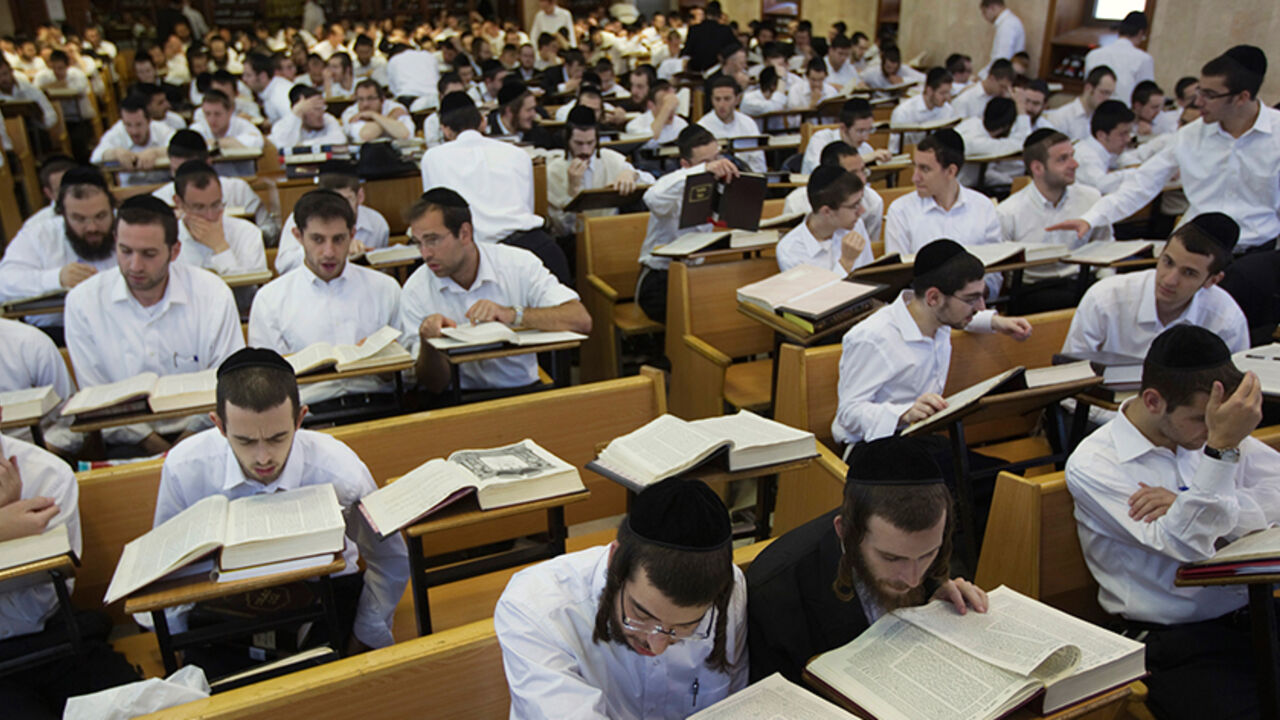
While the image above shows Hasidic men spending hours a day studying in a yeshiva, pouring over Jewish texts — the real learning in Judaism comes in practice. If you know the prayer for lighting sabbath candles but never practice it and notice what that feels like, what good is it? If you know the 613 mitzvot (commandments) but don’t know what they mean for the life of an individual or community, why bother? I’d add to that last one, knowing all 613 commandments liberates you from the cherry-picking and tyranny of the ones we’d rather not talk about (looking at you, Leviticus).
Within this, though, there’s a major hurdle. Some people think there’s one right way to be Jewish. In my experience, a lot of progressive Jews are really hard on converts. Throw into the mix the fact that I have “Rev. Dr.” in front of my name, and it becomes a huge undertaking. I don’t blame my fellow Jews, though. “Rev. Dr.” usually means Christian. But peel back one small layer of history or just visit an old Jewish cemetery, and you’ll see Reform Rabbis buried there with “Rev.” on their tombstones.
There’s an amusing word for new Jews in some circles: Superjews. New Jews tend to learn and practice more than those born into the faith. In my case, as someone who is often assumed to be a Christian minister, I had to go out of my way to be the Superüberjew. I had to make sure I learned as much as I could and show my laurel leaves of knowledge.
But here’s the thing. For many Reform and Reconstructionist Rabbis, what I knew and how I lived didn’t matter. It was the mere fact that I could be assumed to be Christian that disqualified me. Also, a general lack of knowledge over who and what Unitarian Universalists are was a barrier.
The fact that I will not keep 100% kosher was disqualifying, even though only 6% of Reform Jews keep kosher. The fact that my household will have a Christmas tree up in December was disqualifying, even though many Jewish households have Christmas trees and kinda-sorta-maybe celebrate a “secular” Christmas. The fact that in my role as a UU minister, I will still encourage people to find what’s true and right for themselves was disqualifying, but let’s ignore the staggering amount of Jewish Buddhists and the influx of New Age practice in both Reconstructionist and Renewal temples.
I’m not upset by hypocrisy. It’s a human thing to do. Every step of the way when I would experience rejection, my resolve was strengthened…because I knew this was where I needed to be. I needed to be here in order to be a better UU minister, a better husband, son, friend, and so on. So, I kept studying. I kept learning. I kept practicing.
Maybe that’s where the UUs have the edge, despite being on the other end of the spectrum: There’s few barriers to the tribe. But maybe I like some barriers. And now that I’m fully Jewish — my conversion was yotzei (complete or halakhic) — by the book, I get to wrestle with my converging identities within Judaism. It is an amusing thing to expect converts to hold a higher standard than the average people…unless you’re Orthodox.
The first two weeks of wearing progressive lenses, I was sick to my stomach. I felt like I was going to throw up at home, walking, running, in meetings, and even preaching. I was told this was perfectly normal. Now I know how to wear them and it’s as natural as anything else.
It’s like that with converting to Judaism, too. My soul…with an unnerving smile…delivered the news like that Optometrist. I was in need of an adjustment. A Jewish adjustment. Then came the resistance and the waiting…nearly two years of waiting and study.
Putting on the glasses wasn’t the moment of conversion, though. It was the “trial” phase. It was the lead up to the moment where it all settled. And yeah, I was nauseous. Sometimes I wanted to throw up at the whole thought of doing this, or when an especially nasty rejection from an otherwise lovely Rabbi would occur, or when I would sit late at night wondering “Why the !@#$ do you want to be in a tradition with Leviticus as a sacred text?!” But I kept wearing Judaism. I endured the dizziness, the nausea, the long adjustment period.
It wasn’t all bad moments, either. Sometimes things would come into focus beautifully and it all made sense and felt natural. But up to the final moment, before I descended the stairs of the mikveh, I wondered what would happen if I turned back. My gut told me the answer every time. My soul would be out of focus.
There’s a great quote about God from a TV show no one watched in the late 90s and early aughts: Millennium. Sometimes priceless wisdom comes from unexpected places. Anyway, the quote goes like this:
God doesn’t move us by telling us the facts. He moves us by pains and contradictions. He’s given me a lack of understanding: not answers, but questions. An invitation to marvel.
I was exposed to that quote as a 14 year old when that episode first aired and it has stuck with me since. If anyone were to ever ask me what encapsulates my understanding of faith or “God” or the great mystery or whatever you want to call it — it’s that.
An earlier play that I discovered later, also as a teenager, puts it another way. Amusingly enough, it’s from Angels in America by the amazing Jew, Tony Kushner:
Harper: In your experience of the world. How do people change?
Mormon Mother: Well it has something to do with God so it’s not very nice.
God splits the skin with a jagged thumbnail from throat to belly and then plunges a huge filthy hand in, he grabs hold of your bloody tubes and they slip to evade his grasp but he squeezes hard, he insists, he pulls and pulls till all your innards are yanked out and the pain! We can’t even talk about that. And then he stuffs them back, dirty, tangled and torn. It’s up to you to do the stitching.
Harper: And then up you get. And walk around.
Mormon Mother: Just mangled guts pretending.
Harper: That’s how people change
Putting the soul, the spirit, the self, your character — call it what you will — into focus is not always happy go lucky. It can lead down paths of rejection and heartache. The journey does not always feel worthwhile. I would say that such journeys are still good. Good not for their feeling but for their power. Mangled guts and contradictions aplenty.
So, this wasn’t just about studying Judaism in the traditional sense. Not all study is memorization and facts. It was a study in the self. A study in transformation. A study in resilience and commitment.
Every Sabbath, at least two candles are lit. Why at least two? To fulfill the commandment to keep and remember the Sabbath. One candle represents “shamor” (keep) and the other,”zachor” (remember). Keep and remember the times in life when change happened even if it was painful. Keep and remember the longing of the soul. Keep and remember that on the other end of that transition period — full of nausea and doubt — there is a settling in and a great peace.
Until next time.
Here’s five of my (many) favorite books on Judaism for those who want to learn more:
A Medium Length Book About Conversion:
Choosing a Jewish Life by Anita Diamant
A Short Book About Judaism:
Why Be Jewish? by David Wolpe
A Hefty & Erudite but Worthwhile Tome:
God in Search of Man: A Philosophy of Judaism by Abraham Joshua Heschel
An Easy-to-Read Torah Commentary:
It Takes Two to Torah by Abigail Pogrebein & Dov Linzer
A Book I Read Every Year & Would Bring to a Desert Island:
This is Real and You are Completely Unprepared by Alan Lew